Leave Your Message
A large bathroom needs more than a small mat beside the sink. A Long Bathroom Mat can cover the space between the vanity, bathtub, and shower, creating a softer and safer step across hard flooring. However, length alone does not guarantee comfort or performance. The right choice should match your room’s measurements, moisture levels, and daily cleaning habits.
This guide examines seven long bathroom mats using practical criteria, including absorbency, drying speed, surface comfort, backing stability, and washing convenience. A thick microfiber mat may feel warm under bare feet, while cotton can offer a familiar texture and easier laundering. Rubber or latex-style backing may improve grip, but it can still slide on wet or dusty floors. Check the manufacturer’s care instructions carefully. Not every mat tolerates high heat or frequent machine washing.
Measure twice.
Leave doors clear.
Real bathrooms are rarely perfect rectangles. Corners, toilet bases, and cabinet edges can interrupt a seemingly simple fit. We also consider whether each mat curls after washing, traps water beneath it, or develops a musty smell in poorly ventilated spaces. These details matter more than attractive product photography.
The best option depends on your priorities. Families may value quick drying and secure backing. Minimalist bathrooms may need a low-profile design that sits neatly beneath doors. Some shoppers may prefer plush comfort, even if maintenance takes longer. This comparison aims to make those trade-offs clearer, while recognizing one unavoidable truth: no bathroom mat performs perfectly in every home.
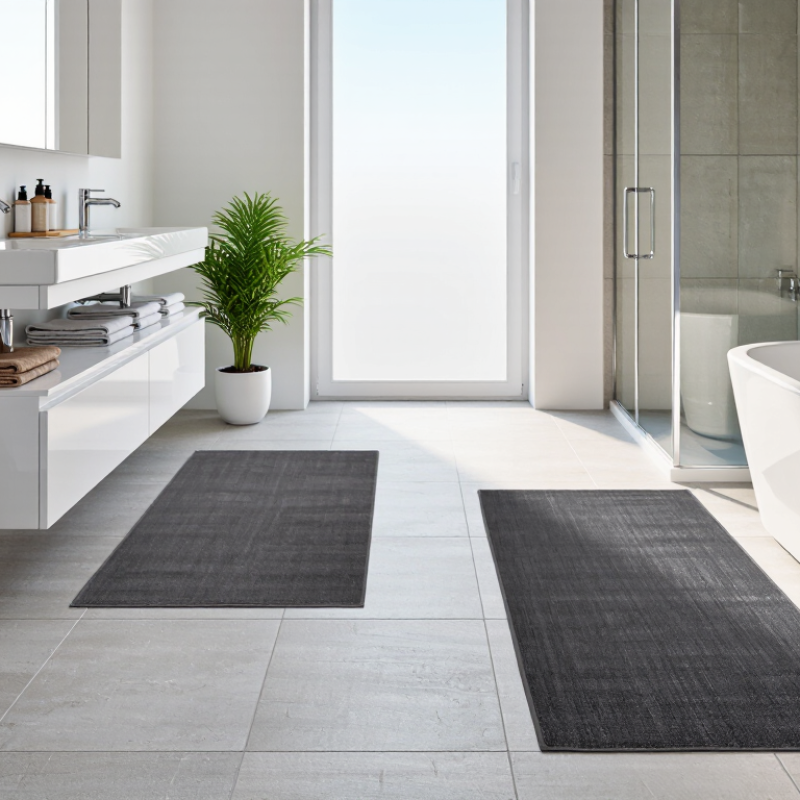
Defining the ideal long bathroom mat starts with proportion, not decoration. A large bathroom needs coverage that connects the shower, vanity, and bathtub without creating a tripping path. The 2024 U.S. Houzz Bathroom Trends Study reported that 33% of renovating homeowners enlarged their showers. That shift makes longer, better-positioned mats more useful. Measure the dry standing area first. A mat should extend along the main exit route, while leaving visible floor around doors and cabinets. In a spacious room, one narrow runner may look attractive but leave wet gaps. Two coordinated mats can work better.
Choose a low-profile mat with firm edge binding, a water-resistant underside, and fibers that dry quickly. Cotton feels comfortable, yet it may stay damp after several showers. Microfiber often dries faster, but performance varies by weave and thickness. The CDC reports that more than 800,000 people are hospitalized yearly because of fall injuries, especially older adults. A secure backing cannot remove every risk, but it can reduce sliding on clean, dry flooring. Avoid mats that curl after washing. I have found that oversized mats can also become awkward near inward-swinging doors. Check the door clearance before buying. Washability matters equally: inspect the care label, launder regularly, and replace a mat when its backing cracks, peels, or loses grip.
| Rank | Long Bathroom Mat Type | Typical Size | Primary Material | Best Use | Absorption & Drying | Safety Features | Care Requirements | Typical Price Range | Overall Rating |
|---|---|---|---|---|---|---|---|---|---|
| 1 | Extra-Long Plush Microfiber Mat | 20 × 60 in (51 × 152 cm) | Polyester microfiber with latex or PVC backing | Wide double-sink vanities and long open floor areas | Very absorbent; dries quickly when hung or laid flat | Textured anti-slip backing; low-profile edge helps reduce tripping | Machine wash cold; tumble dry low; avoid fabric softener | $25–$55 | ★★★★★ |
| 2 | Long Ring-Spun Cotton Mat | 24 × 60 in (61 × 152 cm) | Ring-spun cotton, usually with a woven or tufted finish | Traditional bathrooms that need strong water absorption | Excellent absorption; moderate drying speed because cotton holds moisture | Grip backing is available, but should be checked before purchase | Machine wash and dry; wash separately at first to limit lint transfer | $30–$70 | ★★★★★ |
| 3 | Memory-Foam Comfort Runner | 20 × 60 in (51 × 152 cm) | Polyester or microfiber surface over polyurethane memory foam | Comfort-focused bathrooms where standing support is important | Good surface absorption; slower to dry than thin microfiber | Non-slip backing; cushioned height requires careful placement near doors | Spot clean or use a large-capacity washer if the care label allows | $35–$75 | ★★★★☆ |
| 4 | Low-Profile Woven Cotton Runner | 20 × 60 in (51 × 152 cm) | Flat-woven cotton or cotton-blend fabric | Modern bathrooms with doors or cabinets that need extra clearance | Moderate absorption; typically dries faster than thick cotton pile | Flat profile reduces toe-catching; a separate non-slip pad may be needed | Machine washable; reshape while damp and air-dry when possible | $25–$60 | ★★★★☆ |
| 5 | Quick-Dry Chenille Runner | 24 × 60 in (61 × 152 cm) | Polyester chenille with a water-resistant backing | Busy households needing a soft mat that can be washed frequently | Good absorption; quick-drying fibers help reduce dampness between uses | Rubberized or PVC backing improves stability on smooth flooring | Machine wash cold; dry on low heat and do not iron the backing | $28–$65 | ★★★★☆ |
| 6 | Diatomite Stone Bath Mat | 23.6 × 35.4 in (60 × 90 cm); usually shorter than a runner | Porous diatomaceous earth composite | Minimalist bathrooms that prioritize rapid surface drying | Very fast surface evaporation; does not provide plush cushioning | Requires a level, dry floor; use a compatible anti-slip layer | Wipe clean; lightly sand the surface if the care instructions permit | $30–$80 | ★★★☆☆ |
| 7 | Water-Resistant Bamboo Slat Runner | 20 × 60 in (51 × 152 cm) | Sealed bamboo slats joined with flexible cord or backing | Well-ventilated bathrooms and spaces with a spa-style design | Does not absorb water; allows moisture to evaporate from the floor | Raised slats improve airflow; anti-slip feet or a grip pad are recommended | Wipe regularly, keep dry between uses, and reseal according to instructions | $35–$90 | ★★★☆☆ |
Typical price ranges are approximate U.S. retail ranges for comparable sizes and materials; actual prices vary by construction, thickness, seasonal sales, and care features. Always verify the backing material and care label before placing a mat on smooth or heated flooring.