China has become a practical sourcing destination for Vintage Dinnerware Sets, combining established ceramic skills with flexible wholesale production. Reliable suppliers can offer floral porcelain plates, amber glass goblets, gold-rimmed cups, and complete table collections. Some designs imitate the 1950s. Others use genuinely restored molds or archived patterns.
William Morris, a major design authority, said, “Have nothing in your houses that you do not know to be useful, or believe to be beautiful.” This principle remains valuable when evaluating vintage-style dinnerware. Beauty alone is not enough. Buyers should examine glaze consistency, rim finishing, stacking strength, and food-contact suitability. A charming blue transfer pattern means little if the surface scratches easily.
This guide introduces China’s leading wholesale suppliers and explains how to compare their capabilities. It considers factory experience, customization options, minimum order quantities, sample policies, export packaging, and communication reliability. Suppliers should provide clear product specifications and realistic production timelines. They should also explain whether each piece is handmade, newly manufactured, or genuinely antique.
Details matter. Check the maker’s mark beneath each plate. Inspect the gold line under warm light. Ask for carton-drop testing before shipment. That step is often overlooked.
Not every “vintage” product feels authentic. Some look overly polished and lose the warmth buyers expect. This is where careful sampling becomes essential. A supplier may present beautiful catalog images, yet the physical sample can reveal uneven color, thin handles, or disappointing weight. Thoughtful sourcing requires patience, documentation, and a willingness to reconsider attractive offers.
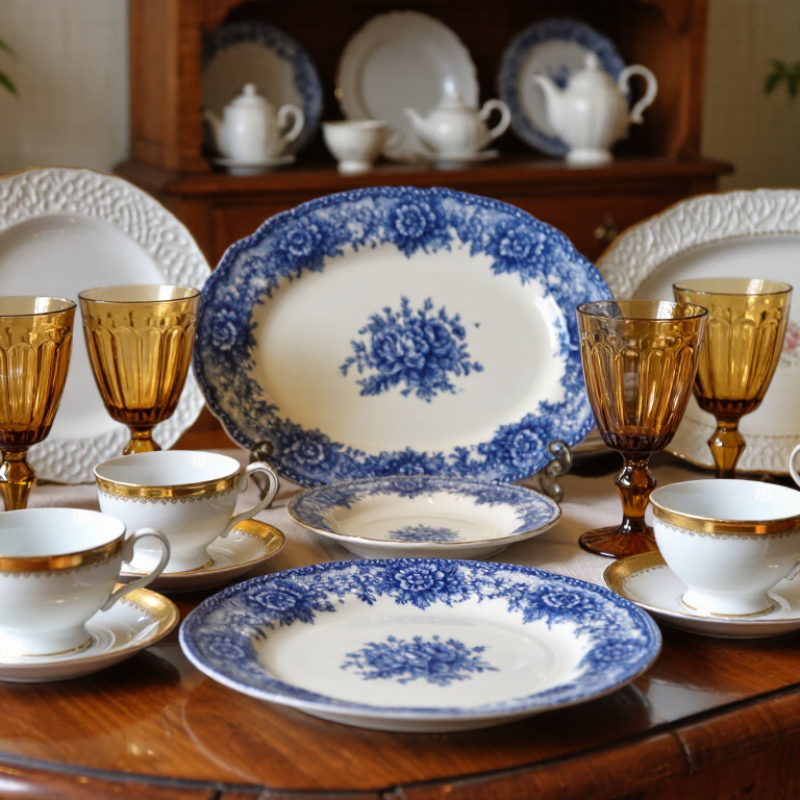
Vintage dinnerware usually refers to tableware made 20 to 100 years ago. It shows period styling, visible age, or an older manufacturing method. An antique is typically older and rarer, so the terms should not be exchanged casually. In China, vintage interest often centers on household ceramics produced from the 1950s through the 1990s. Factories made practical bowls, floral plates, and transfer-printed cups for domestic and export markets. Some patterns now feel nostalgic. The label remains imperfect.
China’s market combines ceramic heritage with efficient wholesale production. Jingdezhen and other production centers preserve hand-finishing skills. Modern factories add mould consistency, repeatable colors, and scalable packaging. UN Comtrade data for 2023 shows China’s ceramic tableware exports under HS 6912 exceeded US$4 billion. This export scale supports low minimum orders, custom patterns, and mixed-container purchasing. Still, “vintage” does not guarantee quality. Some new pieces are intentionally distressed. Wholesale buyers should inspect glaze uniformity, rim smoothness, firing defects, and carton protection. They should also request food-contact testing documents.
The sales channel is changing quickly. China’s National Bureau of Statistics reported online physical-goods retail sales of RMB 13.02 trillion in 2023. That figure increased 8.3 percent year on year. Online sampling lets smaller wholesalers test nostalgic collections before placing larger orders. However, photographs can hide scale, weight, and color variation. In real sourcing, slight repetition flaws sometimes add character. Uneven sizing creates expensive returns, though. Suppliers should disclose whether decoration is handmade, printed, or applied after firing.
Vintage dinnerware generally refers to older tableware collected for its age, craftsmanship, decoration, or historical character. Chinese ceramic traditions developed through major periods including the Han, Tang, Song, Yuan, Ming, and Qing eras. The chart shows the approximate length of these periods associated with the development of ceramic tableware and porcelain culture. Period dates are conventional historical estimates, and the chart is not a supplier ranking or sales report.
Vintage dinnerware sets for wholesale buyers come in several practical categories. Transferware features printed floral, pastoral, or geometric patterns under a protective glaze. It suits cafés, event stylists, and retailers seeking coordinated table settings. Ironstone offers heavier plates, strong edges, and a warm white surface. It often performs well in busy hospitality environments.
Stoneware brings earthy colors, visible texture, and a handmade appearance. Its uneven rims can make each piece feel authentic, though that variation may complicate replacement orders. Porcelain provides a lighter, cleaner look with detailed decoration. It is suitable for boutique dining rooms and gift collections, but buyers should check thickness and chip resistance carefully. Enamel-style metalware adds a nostalgic camping character and usually weighs less than ceramic sets.
Details matter. Ask wholesale suppliers about food-contact testing, glaze safety, firing temperatures, and packaging standards. Request current photographs of plates, bowls, cups, and serving pieces. A sample order reveals more than a catalog. Check the base for wobbling, inspect printed lines for fading, and measure every item against the stated dimensions.
Do not trust “vintage” as a quality promise. Some sets are newly produced with aged-looking finishes. That is not necessarily a problem, but the product description must remain honest. I have seen attractive patterns fail because replacement pieces were unavailable. Buyers should confirm carton quantities, defect allowances, lead times, and shipping protection before committing to a large order. Mistakes happen. Clear records reduce their cost.
China Top Vintage Dinnerware Sets Wholesale Suppliers: How to Evaluate China-Based Vintage Dinnerware Suppliers
A vintage finish can hide weak manufacturing. Evaluate the supplier, not only the photographs. Grand View Research estimated the global tableware market at over USD 40 billion in 2023, showing strong competition and wide quality differences. Ask for factory details, production capacity, and recent export records. Verify trade data through ITC Trade Map when possible.
Request a physical sample before discussing large orders. Check glaze consistency, rim smoothness, flatness, and color under daylight. Rub printed patterns gently with a damp cloth. Inspect every piece for pinholes, warping, and sharp edges. Food-contact test reports should identify lead and cadmium limits clearly. Certificates need matching factory names and product codes. A document without traceable details proves little.
Packaging deserves equal attention. Drop-test one packed carton, then photograph the internal protection. Confirm carton dimensions, gross weight, replacement terms, minimum order quantity, and production lead time in writing. The International Trade Centre highlights product classification and shipment data as useful tools for supplier screening. Still, data cannot confirm daily workmanship. I have seen attractive samples followed by inconsistent second batches. That is the uncomfortable part. Use a pre-shipment inspection, retain an approved sample, and record acceptable defect limits. Vintage should look intentionally aged, not accidentally damaged.
| Evaluation Dimension | What to Verify | Practical Wholesale Benchmark | Required Evidence | Suggested Weight | Score (1–5) |
|---|---|---|---|---|---|
| Vintage Product Definition | Confirm whether the products are genuine pre-owned vintage pieces, newly manufactured vintage-style reproductions, or a mixed collection. | The supplier should provide a clear product classification and avoid describing newly made products as authentic antiques. | Written product description, production date information where available, and dated product photographs. | 12% | __/5 |
| Material and Construction | Check whether the dinnerware is porcelain, stoneware, earthenware, bone china, glass, or another material, and review the firing and glazing process. | Material specifications should remain consistent across the quotation, sample, technical sheet, and shipping documents. | Material declaration, dimensions, weight per piece, glaze description, and sample inspection report. | 10% | __/5 |
| Food-Contact Compliance | Verify that glazes, pigments, decals, and other food-contact surfaces meet the legal requirements of the destination market. | For the European market, request documentation aligned with Regulation (EC) No. 1935/2004 and applicable ceramic food-contact requirements. For the United States, request testing relevant to FDA food-contact requirements. | Recent third-party laboratory reports for lead and cadmium migration, plus a declaration of compliance where applicable. | 15% | __/5 |
| Quality-Control System | Review inspection procedures for dimensions, color variation, glaze defects, chips, cracks, warping, pinholes, and print alignment. | A supplier should use documented incoming, in-process, and final inspections. Acceptance criteria should be agreed before production. | Inspection checklist, defect classification, sample approval record, and pre-shipment inspection results. | 13% | __/5 |
| Authenticity and Provenance | For genuine vintage items, verify the source, ownership history, age claims, repairs, replacements, and condition grading. | Every claimed vintage lot should have item-level or batch-level identification and a transparent condition description. | Provenance records, inventory photographs, condition reports, and written disclosure of restoration or replacement parts. | 10% | __/5 |
| Minimum Order Quantity | Confirm whether the minimum order is calculated by design, color, place setting, carton, or total purchase value. | Use a written MOQ schedule. For mixed vintage inventory, confirm available quantities because repeatability may be limited. | Formal quotation showing MOQ, assortment rules, carton quantity, and sample-order conditions. | 8% | __/5 |
| Sampling and Production Lead Time | Separate sample preparation time from bulk production time and confirm the effect of custom colors, packaging, and artwork. | Request a milestone schedule covering sample approval, production completion, inspection, packing, and shipment booking. | Production timeline, capacity statement, order milestones, and written delay-notification procedure. | 8% | __/5 |
| Packaging and Breakage Protection | Assess individual wrapping, dividers, inner cartons, master cartons, moisture protection, and carton drop-test procedures. | Packaging should prevent contact between pieces and protect edges during international handling. Confirm whether replacement units are available. | Packaging specification, carton dimensions, gross weight, loading photographs, and breakage-claim process. | 10% | __/5 |
| Export Documentation | Check the commercial invoice, packing list, certificate of origin when required, transport documents, and correct customs description. | Ceramic tableware may fall under HS heading 6911 or 6912 depending on material and product classification; the buyer should confirm the applicable code with customs authorities. | Sample commercial invoice, packing list, export declaration process, and agreed Incoterms® 2020 rule. | 7% | __/5 |
| Commercial Terms and Cost Transparency | Compare product price, tooling or setup charges, packaging, inspection, inland transport, freight, taxes, payment terms, and currency. | A reliable quotation should show unit price, validity period, payment schedule, delivery term, excluded costs, and conditions for price changes. | Signed quotation, pro forma invoice, payment instructions, and written policy for shortages, defects, and late delivery. | 7% | __/5 |
| Communication and After-Sales Support | Evaluate response speed, technical understanding, escalation procedures, and support for claims or repeat orders. | Use a written response-time expectation and require a named contact for quality issues, shipping damage, and replenishment requests. | Communication records, after-sales policy, claim-resolution terms, and references from comparable wholesale transactions without disclosing confidential information. | 5% | __/5 |
| Weighted Supplier Evaluation Total | 100% | __/5 | |||
Wholesale pricing depends on clay quality, glazing, decoration, packaging, and order volume. Many suppliers offer tiered quotes, so larger orders usually reduce the unit cost. However, a low price can hide thin plates, uneven rims, or weak protective packaging. Request a sample set before confirming production. Check its weight, color consistency, stackability, and resistance to ordinary washing. Ask for a written quotation covering product cost, packing, tooling, inspection, and shipping terms.
Minimum order quantities vary by pattern and production method. Stock designs may allow smaller orders, while new molds or hand-finished pieces often require higher quantities. Confirm whether the MOQ applies to each color, shape, or complete set. A practical starting order might include two or three patterns, but this can complicate inventory. I would rather test one reliable design than overbuy attractive samples. That judgment is not perfect, especially when seasonal demand changes quickly.
Tips: Ask for price breaks at 100, 500, and 1,000 sets. Request carton dimensions and drop-test details. For customization, provide clear artwork, target colors, logo placement, and dimensions. Confirm decoration limits, sample fees, revision costs, and production time. Vintage effects should look consistent, but slight handmade variation may occur. Approve a signed sample before mass production, and record every agreed detail in the purchase contract.
When sourcing vintage-style dinnerware wholesale, shipping often determines the real cost, not the quoted unit price. Ask suppliers for carton dimensions, gross weight, pallet plans, and a written shipping estimate. Plates arrive safely only when separators, corner protection, and moisture-resistant cartons are specified. Request a pre-shipment sample packed like a commercial order. In my experience, a beautiful sample proves little if the packing line is rushed. Sea freight lowers costs, but port delays can disrupt seasonal sales. Air freight is faster, yet fragile ceramics may need stronger cushioning and insurance.
Quality control should cover appearance and safety. Approve a reference sample showing glaze color, rim shape, weight, and acceptable imperfections. Inspect random cartons before dispatch, not only the top layer. Check for hairline cracks, sharp edges, pinholes, stains, and unstable bases. For food-contact use, request current test reports for lead, cadmium, and other applicable substances. Reports should match the actual materials and production site. This is where buyers sometimes trust paperwork too quickly. Independent inspection costs more, but it can reveal inconsistent sizes and weak inner packaging.
Tips: Confirm the tariff classification, country-of-origin marking, commercial invoice, packing list, and transport document before shipment. Ask a customs broker about duties, taxes, labeling, and local food-contact requirements. Keep all approvals in writing. Build a replacement allowance into your budget, because some breakage is difficult to prevent. I would also order a small pilot shipment before committing to a full container. It may feel slow. It is often cheaper than correcting an entire rejected load.